Operative reports drafted the way the surgeon writes them.
Operon turns short, structured case prompts into full endoscopic spine operative reports that match the surgeon’s templates, terminology, and level-by-level detail — ready for review and signature.
The problem
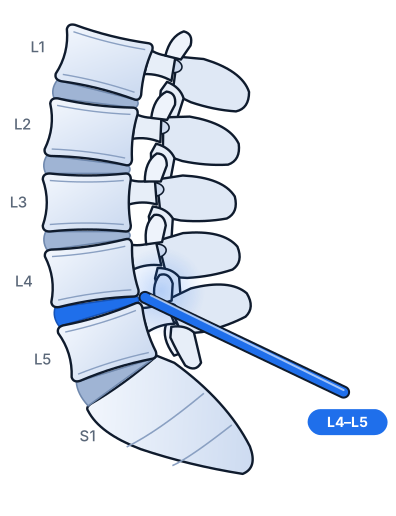
Endoscopic spine notes are narrow and high-stakes. Generic medical writing tools invent anatomy, wrong levels, laterality, or open-surgery steps that do not belong in an endoscopic case. Surgeons rewrite the note — or worse, inherit language that creates clinical and coding risk.
Generic models miss the niche
Cervical and lumbar endoscopy has its own approaches, landmarks, and phrasing. Off-the-shelf text generators do not.
Wrong level or side is not a typo
Level and laterality errors in an operative report are documentation failures with real downstream cost.
Cloud PHI is often a non-starter
Many practices want documentation AI that can run on practice-owned hardware, without sending case text to a public training loop.
How it works
Short structured input in. A complete operative report out — in the surgeon’s voice — then human review before anything is signed.
Prompt the case
Capture the essentials: procedure, level, side, approach, and the operative findings that matter for this note.
Draft in practice voice
Operon expands that prompt into a full endoscopic operative report aligned to the surgeon’s own note library and style.
Review and sign
The surgeon edits freely and signs. Operon drafts; it does not chart, diagnose, or close a note on its own.
What Operon covers
Built for endoscopic spine documentation — not generic OR notes, not open spine templates dressed up as endoscopy.
Practice-matched drafts
Trained against a surgeon’s own operative-note patterns so the output reads like that practice, not a textbook paragraph.
Cervical and lumbar endoscopy
Foraminotomy, discectomy, and decompression language at cervical and lumbar levels — kept in an endoscopic frame.
Local / on-prem capable
Designed to run on practice-owned hardware when privacy and control matter. PHI stays with the practice by design.
Surgeon stays in the loop
Every report is a draft for clinician review and signature. No autonomous charting. No silent finalization.
Safety and scope
Operon is documentation assistance for a defined clinical niche. It is not a decision-support device, and it does not replace the operative surgeon.
-
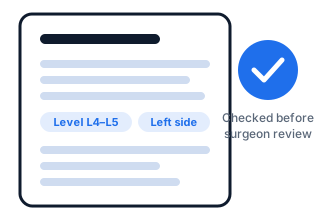
Level and side checksDrafts are screened for operative level and laterality before the surgeon sees them.
-
Endoscopic-only framingScope is endoscopic cervical and lumbar work — not a general-purpose medical writer that slips into open-surgery language.
-
Human signature requiredOperon produces drafts. The surgeon reviews, edits, and signs. Clinical responsibility stays with the clinician.
-
No invented outcome claimsOperon does not claim FDA clearance or fabricate clinical outcome statistics. It drafts operative documentation for review.
Who it’s for
Endoscopic spine surgeons
High-volume cervical and lumbar endoscopy practices that want notes that sound like their own cases.
ASCs and specialty clinics
Groups that need faster, more consistent op-report turnaround without handing documentation to a generic cloud chatbot.
Privacy-sensitive deployments
Teams that prefer practice-owned inference hardware and tight control over where case text lives.
Who is behind it
Operon is built by Catalino Dureza, MD, MBA, a board-certified neurosurgeon who has practiced spine surgery for decades and performs endoscopic spine surgery at both cervical and lumbar levels. The product grew out of his own practice’s need for accurate, detailed operative documentation — not a generic healthcare chatbot project.
Product and legal entity: Operon Spine AI LLC (California).
Contact
For early access, partnerships, or technical questions:
833 Auto Center Drive, Suite E
Palmdale, CA 93551